Rohingya Refugee Camp Cox’s Bazar:
Density as the Main Risk Multiplier
What has changed since my August 2023 analysis
In August 2023, I wrote that density would become the central problem in the Rohingya refugee camps in Cox’s Bazar. Today, in 2026, this concern has unfortunately been confirmed. Density is no longer only a spatial issue. It has become the multiplier of almost every other risk: fire, heat stress, limited emergency access, overloaded water and sanitation systems, health risks, social tensions, protection concerns and the lack of long-term liveability.
This article links back to my original 2023 LinkedIn post and updates the discussion with the latest available population figures, the limited decongestion effect of Bhasan Char, and the growing risks in Cox’s Bazar.
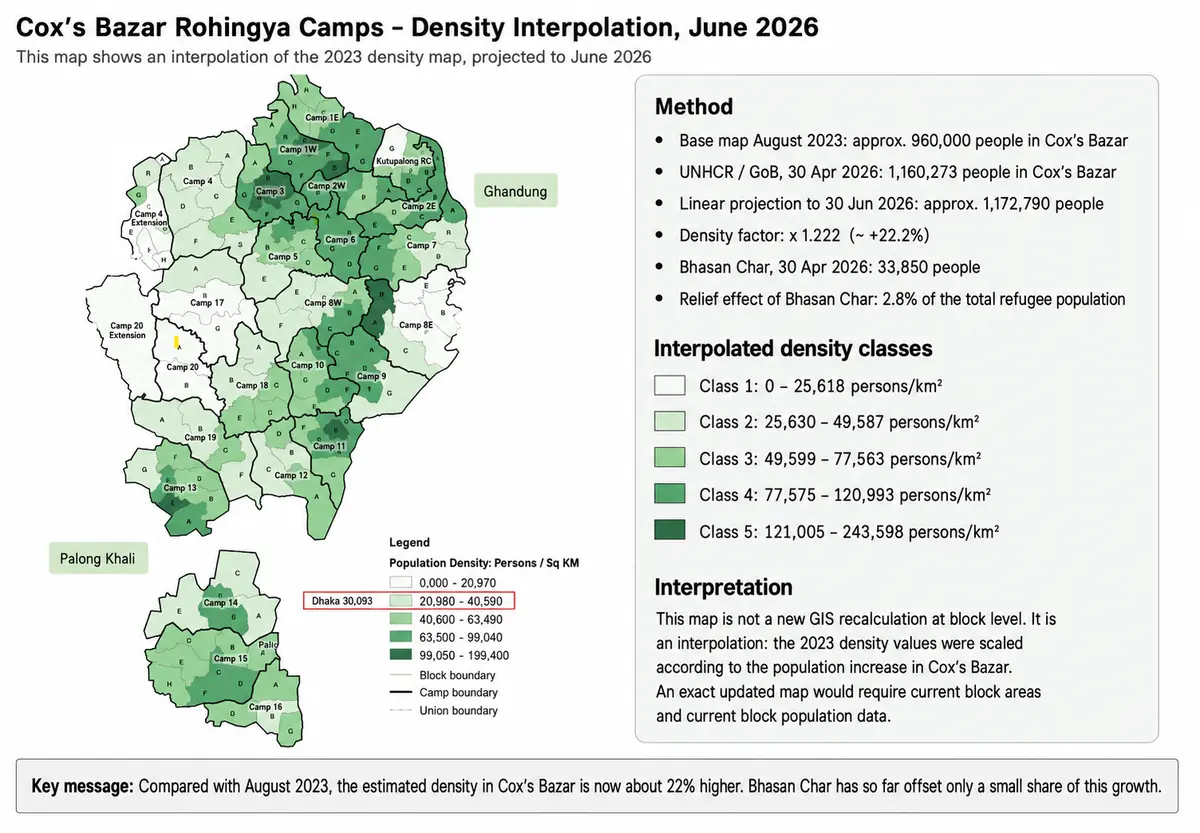
1. Population growth has not been brought under control
In 2023, the Rohingya refugee population in the Cox’s Bazar camp context was commonly referred to as approximately 960,000 people. Today, the total number of Rohingya refugees in Bangladesh is around 1.19 million. More than 1.16 million people continue to live in Cox’s Bazar, while only around 34,000 people are accommodated on Bhasan Char.
This means that the decongestion effect of Bhasan Char is real, but very limited in relation to the scale of the overall problem. Today, it represents only around three percent of the total refugee population. Even if Bhasan Char were fully used up to its originally planned capacity of approximately 100,000 people, Cox’s Bazar would remain an extremely overcrowded and highly vulnerable settlement area.
2. Cox’s Bazar is no longer a temporary emergency settlement
From the perspective of planning, site management and humanitarian infrastructure, Cox’s Bazar can no longer be understood as a temporary refugee camp. It has effectively grown into a highly dense urban settlement structure.
The original camp system was established as an emergency response. After almost nine years, however, it has become a permanent informal urban settlement — without the spatial reserves, infrastructure standards, access systems, freedom of movement and economic opportunities that a settlement of this size would normally require.
Cox’s Bazar is therefore no longer just a camp. It is a city-sized humanitarian settlement without city status, without genuine urban governance and without the long-term planning instruments that a settlement of this scale urgently needs.
3. Density has become the main risk multiplier
The consequences are visible: emergency and rescue access remains restricted; fire can spread rapidly through densely arranged bamboo and tarpaulin structures; slopes, monsoon rains and landslides remain constant risks; water, sanitation and hygiene systems are overloaded by population growth and ageing infrastructure; heat, poor ventilation and the lack of open space increase health risks.
The central planning problem is not only that many people live in a very limited area. The central problem is that a temporary humanitarian system is expected to function under the conditions of permanent urban growth.
4. The security situation has deteriorated significantly
Since 2023, not only the spatial situation has deteriorated, but also the security situation. Reports by UNHCR and other actors show a significant increase in serious security incidents, including killings, abductions, intimidation, recruitment, extortion and violence by organised groups.
In an overcrowded camp, not only fire spreads more quickly. Fear, control by armed groups, social tension and dependency can also spread more easily. Tight spatial conditions, lack of privacy and the absence of legal livelihood opportunities create an environment in which protection risks increase.
5. Humanitarian support is becoming more fragile
Another major change since 2023 is the increasing funding crisis. International attention is declining, while needs continue to grow. The Rohingya remain almost entirely dependent on humanitarian assistance: food, water, health care, education, protection, energy and basic infrastructure all depend on international funding.
This means that the camps are growing, the infrastructure is ageing, the risks are increasing, but the available resources are becoming more limited. This is a dangerous combination.
6. Bhasan Char: a physical decongestion option, but not a simple solution
Bhasan Char was developed by the Government of Bangladesh as a decongestion site. The basic idea is understandable: Cox’s Bazar is overcrowded, exposed to multiple hazards and hardly expandable in spatial terms. A planned settlement with more space, more stable shelters, clearer infrastructure, cyclone protection, drainage and more predictable service delivery could reduce risks for part of the population.
However, any larger relocation can only be justified if it is genuinely voluntary, rights-based, service-equivalent and supported by robust transport, health care, WASH, protection, education, livelihoods, disaster preparedness and independent monitoring. Without these conditions, Bhasan Char remains humanitarianly problematic. With these conditions, it could become an important component of a controlled decongestion strategy.
7. What is needed now
Cox’s Bazar urgently needs a new density and risk strategy. In my view, this should include a Camp Density Risk Index that does not only measure the number of people per area, but also takes into account emergency access, firebreaks, shelter materials, slope and flood risk, WASH pressure, health access, heat exposure, security incidents, protection risks and the capacity of alternative sites such as Bhasan Char.
The central question is no longer simply: Is the camp dense? The real question is: What level of density is still responsible under which risk conditions?
Conclusion
Since my post in August 2023, the situation has not improved. On the contrary: the population has grown, new refugees have arrived, the security situation has deteriorated, funding has become more fragile and humanitarian infrastructure is under increasing pressure.
Bhasan Char remains a potential component of a decongestion strategy, but it is not a miracle solution. Cox’s Bazar cannot continue to grow indefinitely. If we take protection seriously, we must also take space, infrastructure, safety, dignity and long-term liveability seriously.
Density is no longer only a problem in the Rohingya camps. Density has become the main risk multiplier.
Sources and references
UNHCR / Government of Bangladesh population data, Joint Response Plan 2025–2026, UNHCR Bangladesh Annual Results Report 2024, and the original LinkedIn post from August 2023.
UNHCR Operational Data Portal – Bangladesh
Joint Response Plan 2025–2026
UNHCR Bangladesh Annual Results Report 2024
Original LinkedIn post, August 2023